Facts · medicine residues explained · evidence
Filtering medicine residues from tap water: what really works?
Medicine residues can be reduced in tap water. Activated carbon and reverse osmosis in particular can reduce various medicine residues. How well a water filter does this differs per substance and per filter. Independent laboratory tests of the complete filter therefore give you more information than the mere claim that a filter 'removes medicine residues'.
Very small amounts of medicine residues or breakdown products are sometimes found in Dutch tap water. According to the RIVM (the Dutch National Institute for Public Health and the Environment), these concentrations are far below the levels at which health effects are expected in humans.
An additional water filter is therefore not needed to drink Dutch tap water safely. If you want to reduce the amount of unwanted substances in your drinking water even further, you can of course choose to do so.
How do medicine residues end up in our water?
After use, medicines are not always completely broken down by the body. Residues can end up in the sewer via urine and faeces. Medicines applied to the skin, such as certain creams and ointments, can also end up in waste water when we wash.
Sewage treatment plants remove some of these substances, but not all of them. They are simply not designed specifically to remove all micropollutants.
As a result, medicine residues eventually end up in surface water.
According to the RIVM, at least 190 tonnes of medicine residues reach surface water in the Netherlands every year. The actual amount may be higher, because, among other things, over-the-counter medicines, medicines from specialist care and certain breakdown products are not fully included in this estimate.
Are there medicine residues in Dutch tap water?
Yes, very small amounts are sometimes found.
Dutch drinking water is made from groundwater and surface water. According to the RIVM, medicine residues are found more often, and in higher concentrations, in surface water sources than in groundwater sources.
During drinking water treatment, the concentrations are reduced considerably. Even so, tiny amounts of medicine residues or breakdown products can sometimes still be found.
The RIVM mentions, for example:
- metformin;
- iomeprol;
- guanylurea, a breakdown product.
According to the RIVM, the concentrations found are far below the concentrations at which health effects are expected in humans.
Why are medicine residues still a problem?
The main concern at the moment is not the safety of Dutch tap water, but the aquatic environment and our drinking water sources.
Medicines are biologically active substances. In Dutch surface water, for example, painkillers, antibiotics, blood pressure medication, antidepressants and anti-epileptics have been found.
For several substances, concentrations are measured that are above the risk limits for organisms living in the water.
In addition, a heavier load on rivers and other drinking water sources means that water companies have to make more effort to produce clean drinking water.
Can you filter medicine residues out of tap water?
Yes. Various filtration techniques can reduce medicine residues.
Medicine residues are not a uniform group, however. Medicines differ greatly in their chemical properties. A filter that reduces one medicine very well does not automatically reduce every other medicine equally well.
| Filtration technique | Reduces medicine residues? | Note |
|---|---|---|
| Activated carbon | Yes | Effectiveness varies by medicine and filter |
| Reverse osmosis | Yes | Can greatly reduce many dissolved micropollutants |
| Sediment filter | Not specifically | Mainly intended for suspended particles |
| Ceramic alone | Not a given | Performance depends on the complete filter element |
That is why the question 'does this system filter medicine residues?' is actually too general.
A better question is:
Which medicine residues were actually tested, how much of them was reduced, and up to what filter capacity?
How does activated carbon work against medicine residues?
Activated carbon has a very large internal surface area. Various organic substances can attach themselves to it. This process is called adsorption.
Many organic micropollutants, including various medicine residues, can be reduced this way.
Performance depends, among other things, on:
- the specific medicine;
- the filter material used;
- the amount of filter material;
- the contact time with the water;
- other substances in the water;
- the amount of water that has already been filtered.
The mere presence of activated carbon therefore does not prove how well a complete water filter reduces medicine residues.
Does reverse osmosis work against medicine residues?
Yes. Reverse osmosis can greatly reduce many medicine residues and other dissolved micropollutants.
In reverse osmosis, often abbreviated to RO, water is forced under pressure through a very fine membrane.
An RO system does have different characteristics from, say, a gravity filter. It is usually connected to the water mains, produces a waste water stream and, besides unwanted substances, also removes a large share of the naturally occurring dissolved minerals.
Which water filters have actually been tested for medicine residues?
For consumers it is hard to tell how well a filter works from the filter material used alone.
That is why we prefer to look at independent laboratory tests of the complete filter element.
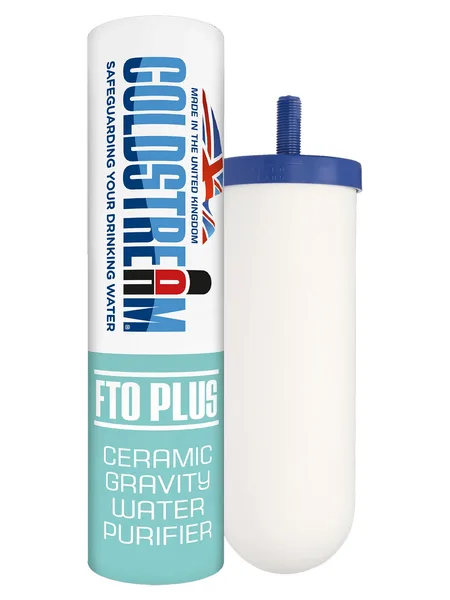
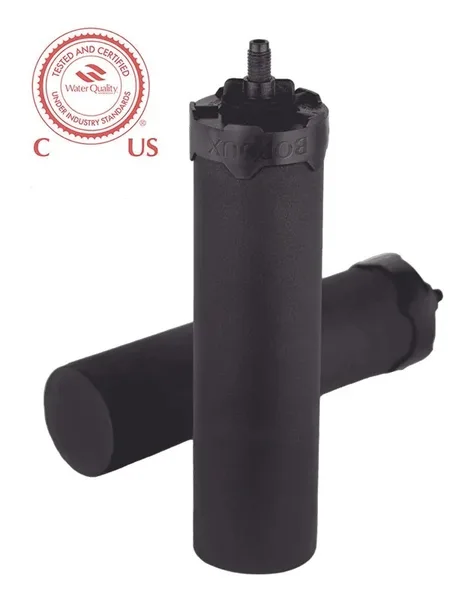
Two examples for which extensive test results are available are the BOROUX Foundation and Coldstream FTO Plus.
BOROUX Foundation and medicine residues
The BOROUX Foundation has been examined by IAPMO R&T Lab in New Jersey, using the NSF/ANSI 401 test methodology, for pharmaceutical substances and other so-called emerging compounds.
The published results include eight pharmaceutical substances.
| Substance tested | Concentration before filtration | Average after filtration | Calculated reduction | Tested up to* |
|---|---|---|---|---|
| Atenolol | 200 ng/L | 12 ng/L | 94.0% | 200 gallons |
| Carbamazepine | 1,400 ng/L | 42 ng/L | 97.0% | 250 gallons |
| Estrone | 140 ng/L | 3 ng/L | 97.9% | 250 gallons |
| Ibuprofen | 400 ng/L | 22 ng/L | 94.5% | 200 gallons |
| Meprobamate | 400 ng/L | 14 ng/L | 96.5% | 200 gallons |
| Naproxen | 140 ng/L | 2 ng/L | 98.6% | 250 gallons |
| Phenytoin | 200 ng/L | 3 ng/L | 98.5% | 250 gallons |
| Trimethoprim | 140 ng/L | 6 ng/L | 95.7% | 250 gallons |
*The capacity stated applies per BOROUX Foundation filter element tested. 200 gallons is about 757 litres and 250 gallons about 946 litres.
The reduction percentages in the table above have been calculated from the concentrations before and after filtration published in the laboratory report.
What does the tested capacity mean?
The 200 and 250 gallons mentioned are test capacities, not prescribed replacement points.
During laboratory tests, fixed concentrations of the substances under investigation are used. These test concentrations can be considerably higher than the very small amounts of medicine residues found in Dutch tap water.
A test up to 250 gallons, for example, therefore does not mean that the filter has to be replaced after 250 gallons, or that it stops working after that. Conversely, the difference in concentration cannot be used to calculate how much longer a filter will last in Dutch tap water. Filter capacity is influenced by the full composition of the water, not just by a single medicine residue.
There is therefore no universal replacement interval for the reduction of all substances. Actual performance depends on, among other things, the concentrations of substances in the water, the overall composition of the water, usage and the amount of water that has passed through the filter.
It is also important that tested according to NSF/ANSI 401 does not automatically mean the same as fully NSF/ANSI 401 certified for every reduction claim.
The results do show how the complete BOROUX Foundation filter performed under the defined test conditions for the eight pharmaceutical substances examined.
Coldstream FTO Plus and medicine residues
The Coldstream FTO Plus (CF163W) filter element has also been extensively tested.
The published performance report contains results for 30 substances that the report lists under the category 'Pharmaceuticals'. These include various medicines, but also other organic micropollutants.
A selection of the medicines actually tested:
| Substance tested | Concentration before filtration | After 3,000 litres | Reduction |
|---|---|---|---|
| Ibuprofen | 418 µg/L | 3.2 µg/L | 99.23% |
| Trimethoprim | 133 µg/L | <0.01 µg/L | >99.99% |
| Naproxen | 182 µg/L | <0.01 µg/L | >99.99% |
| Acetaminophen (paracetamol) | 273 µg/L | <0.01 µg/L | >99.99% |
| Ciprofloxacin | 1,041 µg/L | <0.01 µg/L | >99.99% |
| Sulfamethoxazole | 186 µg/L | <0.01 µg/L | >99.99% |
| Fluoxetine | 1.83 µg/L | <0.01 µg/L | >99.45% |
| Diclofenac | 206 µg/L | <0.01 µg/L | >99.99% |
| Carbamazepine | 1,842 µg/L | <0.01 µg/L | >99.99% |
| Phenytoin | 191 µg/L | <0.01 µg/L | >99.99% |
| Meprobamate | 449 µg/L | 12.6 µg/L | 97.19% |
| Atenolol | 209 µg/L | <0.01 µg/L | >99.99% |
This is only a selection. The report also contains results for estrone, estradiol, gemfibrozil and primidone, among others.
Here too, the test capacity matters.
The 3,000 litres is the measuring point of these laboratory results and not automatically the recommended service life of the filter. For the FTO Plus filter, the performance document states a rated capacity of 1,500 litres and advises replacing the filter at least every six months.
The laboratory test therefore shows what was measured at 3,000 litres under the test conditions in question. It should not be concluded from this that the manufacturer recommends a service life of 3,000 litres.
BOROUX Foundation or Coldstream FTO Plus for medicine residues?
Both filters have laboratory data showing that various medicine residues can be greatly reduced.
A direct comparison based on the percentages alone is not entirely fair, however. The concentrations used, test methods, test set-ups and capacities differ.
There are clear differences in the data available, though:
- BOROUX Foundation was examined according to the NSF/ANSI 401 test methodology for eight pharmaceutical substances. For each substance, the published results state the concentration before and after filtration and a tested capacity of 200 or 250 gallons per filter element.
- Coldstream FTO Plus has a broader published list of results, covering 30 substances that the laboratory report lists under the category 'Pharmaceuticals'. These include various medicines. The performance report contains measurements at 3,000 litres. The stated service capacity of the filter itself is 1,500 litres.
The same starting point therefore applies to both:
Don't just look at the highest reduction percentage, but also at the specific substance, the test conditions and the amount of water at which the performance was examined.
Do laboratory results mean you will get exactly the same percentage at home?
No.
Laboratory tests are valuable because a filter is examined under controlled and reproducible conditions. To measure performance properly, fixed concentrations of the substances under investigation are added to the test water.
The composition of Dutch tap water is different, and the concentrations of medicine residues found in it are usually much lower.
Actual performance and service life can be influenced by, among other things:
- the composition of the tap water;
- the concentration of a particular substance;
- other substances in the water;
- the amount of water that has already passed through the filter;
- the flow rate;
- use and maintenance.
A laboratory result therefore shows how the filter performed under the test conditions described. It is no guarantee that exactly the same reduction percentage or capacity will be achieved at home.
What should you look out for with a water filter for medicine residues?
Pay particular attention to these points:
1. Which substances were actually tested?
A test on ibuprofen does not automatically say anything about every other medicine.
2. Has the complete filter been tested?
A general property of activated carbon is less specific than a laboratory test of the actual filter element.
3. Who carried out the test?
Independent laboratory results give you more to go on than a claim from a manufacturer or seller alone.
4. Up to how many litres was it tested?
A reduction percentage is more informative when it is also clear how much water passed through the filter during the test. This is not automatically the point at which the filter has to be replaced in practice.
5. Is it about testing or certification?
Tested according to an NSF/ANSI standard and NSF/ANSI certified do not mean the same thing.
Is a water filter against medicine residues necessary in the Netherlands?
No. An additional water filter is not necessary to drink Dutch tap water safely.
According to the RIVM, medicine residues currently pose no threat to the quality of Dutch drinking water. The amounts sometimes found in drinking water are far below the concentrations at which health effects are expected.
If you want to reduce your exposure to certain unwanted substances even further, you can choose additional filtration.
In that case, we advise above all looking at the laboratory results of the specific filter.
Conclusion
Medicine residues can occur in very small amounts in Dutch tap water, but according to the RIVM, the current concentrations pose no threat to the quality of drinking water.
If you still want to reduce medicine residues further, you can opt for additional water filtration. Activated carbon and reverse osmosis can reduce various medicine residues.
Not every filter and not every medicine residue behaves in the same way, however.
The BOROUX Foundation and Coldstream FTO Plus are examples of filters for which extensive laboratory data is available. BOROUX Foundation was examined according to the NSF/ANSI 401 test methodology for eight pharmaceutical substances. For Coldstream FTO Plus, results have been published for 30 substances that the laboratory report lists under the category 'Pharmaceuticals', including various medicines.
That is why we prefer to look at actual laboratory results per substance rather than at the general claim that a water filter 'removes medicine residues'.
FREQUENTLY ASKED QUESTIONS
Are there medicine residues in Dutch tap water?
Yes. Very small amounts of medicine residues or breakdown products are sometimes found in Dutch drinking water. According to the RIVM, these concentrations are far below the levels at which health effects are expected in humans.
Is Dutch tap water unhealthy because of medicine residues?
No. According to the RIVM, medicine residues currently pose no threat to the quality of Dutch drinking water.
Can activated carbon filter medicine residues out of water?
Yes. Activated carbon can reduce various organic micropollutants, including certain medicine residues. Effectiveness varies by substance and by filter.
Can reverse osmosis remove medicine residues?
Yes. Reverse osmosis can greatly reduce many dissolved micropollutants. Actual performance varies by substance and system.
Does BOROUX Foundation filter medicine residues?
Yes. BOROUX Foundation has been examined by IAPMO R&T Lab, using the NSF/ANSI 401 test methodology, for eight pharmaceutical substances. The published results show strong reductions for the substances examined.
The test capacity of 200 or 250 gallons does not mean the filter then has to be replaced automatically. The test concentrations and conditions differ from Dutch tap water, and the actual service life depends on the composition of the water and on use.
Does Coldstream FTO Plus filter medicine residues?
Yes. Laboratory results have been published for various medicines for the Coldstream FTO Plus CF163W filter. At the 3,000 litre measuring point, reductions of more than 99% were measured for many of the medicines examined.
The 3,000 litres is a measuring point from the laboratory test and not the recommended service life. The stated service capacity of the filter is 1,500 litres.
Does every gravity filter remove medicine residues?
No. How well it works is determined mainly by the filter element used, and not by the fact that water flows through the system by gravity. So look at the test results of the specific filter.
Is a water filter needed because of medicine residues?
No. According to the RIVM, Dutch tap water can be drunk safely. An additional filter is a personal choice if you want to reduce certain unwanted substances even further.
Sources
- RIVM: Medicines and the environment
- RIVM: How do medicines end up in the environment?
- RIVM: Effects on drinking water and drinking water sources
- RIVM: Medicine residues and water quality, an update
- BOROUX Foundation: overview of independent laboratory tests
- IAPMO R&T Lab: BOROUX Foundation NSF/ANSI 401 Group 1
- IAPMO R&T Lab: BOROUX Foundation NSF/ANSI 401 Group 2
- IAPMO R&T Lab: BOROUX Foundation NSF/ANSI 401 Group 3
- Coldstream FTO Plus CF163W: Performance Data Sheet