Explained · microplastics in tap water
Microplastics in tap water: what are they, how do you measure them and what helps?
Microplastics are tiny plastic particles that can also be found in drinking water. How many particles are found depends heavily on the measuring method used. Some water filters can reduce microplastics, but look at specific test results. A general filter claim or a stated pore size is not enough proof that microplastics have actually been tested.
What are microplastics?
Microplastics are very small particles of plastic. An upper limit of 5 millimetres is often used.
They can enter the environment directly as small particles, or form when larger pieces of plastic slowly break apart.
Examples of sources are:
-
tyre wear;
-
synthetic clothing fibres;
-
paint and coatings;
-
packaging material;
-
breakdown of larger plastic waste.
Microplastics are now found in water, soil and air.
And what are nanoplastics?
Besides microplastics, people increasingly talk about nanoplastics. These are even smaller plastic particles.
The precise boundary between microplastics and nanoplastics is not defined in the same way everywhere. Measuring very small plastic particles in particular is technically difficult.
That distinction matters when you look at water filters.
If a filter has been tested for microplastics above a certain size, that does not automatically mean it also removes all the smaller nanoplastics.
Are there microplastics in Dutch tap water?
Microplastics have been detected in drinking water. That does not mean every glass of Dutch tap water contains a fixed amount of microplastics.
The numbers measured can differ greatly between studies. An important reason for this is that different sampling and analysis methods are used. Very small plastic particles in particular are hard to measure reliably.
The RIVM states that Dutch tap water is of good quality. The presence of microplastics therefore does not mean that Dutch tap water should be regarded as unsafe.
Are microplastics in drinking water harmful?
On the basis of the data available, not all questions about possible health effects can be answered yet.
In its assessment of microplastics in drinking water, the World Health Organization (WHO) concluded that, on the basis of the data available at the time, there was no indication of a clear health risk. At the same time, the WHO pointed to important knowledge gaps and the need for more research.
The RIVM also states that little is yet known about the effects of microplastics on the human body.
It is therefore important to keep two things apart:
microplastics are demonstrably present in our living environment, but that does not automatically mean that the amounts in Dutch tap water pose a health risk.
How are microplastics in water measured?
You cannot reliably measure microplastics with an ordinary household water test.
Laboratories use specialised analysis methods for this. Depending on the study, microscopic and spectroscopic techniques may be used, for example.
The method used influences which particles are found.
A study that can only detect larger particles may therefore give a different result from a study that can measure much smaller particles.
That makes it difficult to compare the numbers of microplastics from different studies directly.
Can you filter microplastics out of tap water?
Yes, certain water filters can reduce microplastics.
With particles, physical filtration plays an important role. Actual performance does depend, however, on the complete filter element, the size of the particles and the conditions in which the filter was tested.
That is why we consider a statement such as:
'This filter can hold back very tiny particles, so it removes microplastics.'
insufficient proof of a specific microplastics claim in itself.
A specific laboratory test or certification for microplastics reduction tells you much more.
BOROUX Foundation and microplastics
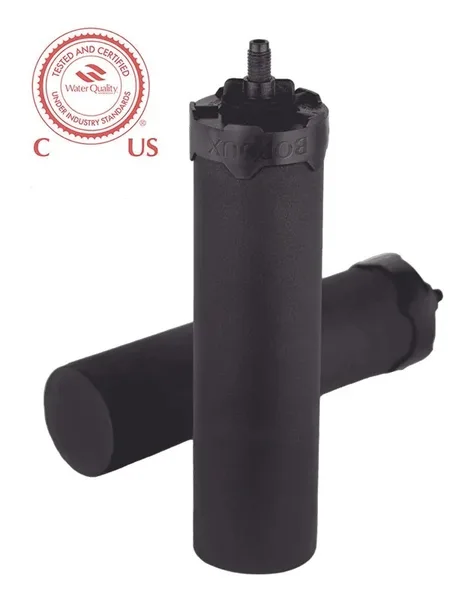
Microplastics reduction has been specifically examined for the BOROUX Foundation filters.
BOROUX Foundation is certified by WQA for microplastics reduction according to NSF/ANSI/CAN 401. The certification relates to microplastics in the tested particle category of ≥0.5 µm to ≤1.0 µm.
The Performance Data Sheet states an average reduction of 98.9% for this test.
That matters because this is not just a theoretical assumption based on filter material or pore size. Microplastics reduction is actually a specific claim within the certification.
Here too there is a limitation:
a certification for this tested particle size does not automatically mean that all smaller nanoplastics are removed.
Black Berkey and microplastics
With Black Berkey filters, the situation is different.
Berkey has published extensive laboratory data for various types of contaminants and very small particles.
For microplastics, however, according to Berkey itself, no specific test has been carried out on which an official reduction claim can be based.
Berkey states that other filtration data indicate that Black Berkey filters can probably hold back larger microplastic particles. That is not the same as a specific laboratory test for microplastics, however.
That is why we do not quote a specific reduction percentage for microplastics for Black Berkey.
Coldstream FTO Plus and microplastics
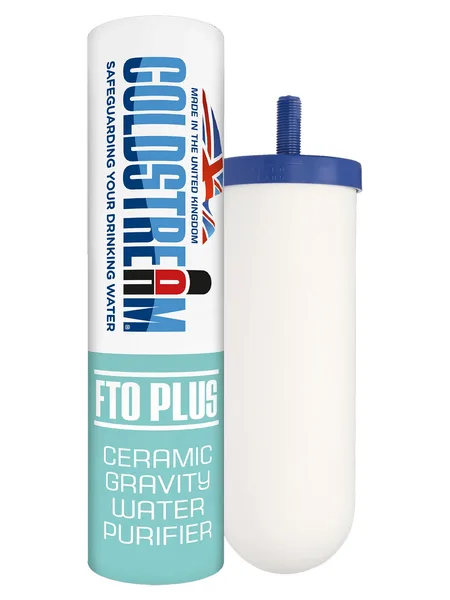
The Coldstream FTO Plus filter combines a ceramic outer layer with activated carbon and other filter media.
Specific data on particles and microplastics have also been published for this filter.
The Performance Data Sheet of the Coldstream FTO Plus CF163W states a reduction of 99.9% for Particle Reduction Class 1, including microplastics.
That is an important difference from a general assumption based on the pore size of a ceramic filter. In this case, the manufacturer actually mentions microplastics in the published performance data.
Some caution is needed when comparing with BOROUX. Different test methods, particle sizes and test conditions can mean that the percentages are not directly comparable.
What does NSF/ANSI 401 say about microplastics?
NSF/ANSI 401 is used for various so-called emerging compounds and also contains a specific claim for microplastics reduction.
An important detail is that a filter certified to NSF/ANSI 401 is not automatically certified for every possible claim within that standard.
So you need to check whether microplastic reduction is actually part of the certification of the filter in question.
That principle also applies to other NSF/ANSI standards.
You can read more about this in our article What does a water filter test report contain?.
Which water filter should you choose for microplastics?
If microplastics are an important reason for you to filter tap water, look above all at these points:
1. Has the filter been tested specifically for microplastics?
2. Which particle size was examined?
3. Is it a laboratory test or a certification?
4. Under which conditions was the performance examined?
5. Does it talk only about microplastics, or about nanoplastics too?
That last distinction in particular is important.
A filter can perform excellently for the microplastics it was tested on, without that proving that all much smaller plastic particles are removed as well.
Conclusion
Microplastics occur in our living environment and have also been detected in drinking water. How many particles are found depends heavily on the measuring method used, and smaller particles in particular are difficult to study.
Dutch tap water is of good quality. An additional water filter is therefore not necessary to drink Dutch tap water safely.
If you still want to reduce microplastics further, you can look for a water filter with demonstrable performance for microplastics. Specific laboratory tests and certifications tell you more here than a theoretical pore size alone.
For BOROUX Foundation, microplastics reduction is specifically certified according to NSF/ANSI/CAN 401, with an average reduction of 98.9% for the tested particle category. For Coldstream FTO Plus, the Performance Data Sheet states a 99.9% reduction of Particle Reduction Class 1, including microplastics. According to Berkey itself, Black Berkey has no specific microplastic test on which an official reduction claim can be based.
You cannot automatically compare the percentages of different filters directly when the test methods and conditions differ.
So don't just look at how finely a filter says it filters, but above all at what has actually been tested.
FREQUENTLY ASKED QUESTIONS
Are there microplastics in Dutch tap water?
Microplastics have been detected in drinking water. The numbers measured differ per study and analysis method. Their presence does not mean that Dutch tap water is regarded as unsafe.
Can I measure microplastics myself?
Not reliably with an ordinary household water test. Specialised laboratory techniques are needed to identify and measure microplastics.
Can a water filter remove microplastics?
Certain water filters can reduce microplastics. Preferably look at specific laboratory tests or certifications, and check which particle size was actually examined.
Does BOROUX Foundation filter microplastics?
Yes. BOROUX Foundation is certified by WQA according to NSF/ANSI/CAN 401 for microplastics reduction in the tested particle category of ≥0.5 µm to ≤1.0 µm. The Performance Data Sheet states an average reduction of 98.9%.
Does Coldstream FTO Plus filter microplastics?
In the Performance Data Sheet of the FTO Plus CF163W, Coldstream states a reduction of 99.9% for Particle Reduction Class 1, including microplastics.
Does Berkey filter microplastics?
Berkey states that Black Berkey Elements have not been tested specifically for microplastics. Other filtration data make a reduction of larger plastic particles plausible, but that is not the same as a specific microplastic test.
Are microplastics the same as nanoplastics?
No. Nanoplastics are even smaller plastic particles. Definitions and measuring methods differ, and research into these very small particles is complex. A test for microplastics therefore does not automatically prove the same reduction for smaller nanoplastics.
Sources
- RIVM: Drinking water quality
- RIVM: Plastics and health
- WHO: Microplastics in drinking-water
- NSF: certified filters with Microplastics Reduction
- BOROUX Foundation: independent tests and certifications
- BOROUX Foundation: Performance Data Sheet
- Berkey: Black Berkey Elements and plastic fibers
- Coldstream FTO Plus CF163W: Performance Data Sheet
From the shop
Filtering PFAS from tap water: what really works? · How does a gravity filter work? · What does a water filter test report contain?