Facts · PFAS explained · evidence
Filtering PFAS from tap water: what really works?
PFAS can be filtered out of tap water. Activated carbon, ion exchange and reverse osmosis in particular can reduce PFAS. However, how well a water filter does this depends heavily on the type of filter, the specific PFAS substance, the amount of water already filtered and the conditions in which the filter is used. So don't just look at the claim 'filters PFAS', but above all at independent test results.
Dutch tap water is safe to drink. Even so, small amounts of PFAS can be present in it. If you want to reduce your exposure to PFAS even further, you can therefore opt for additional water filtration.
But which water filter actually works for this? And how do you know whether a filter really reduces PFAS?
In this guide we explain it.
What are PFAS?
PFAS stands for per- and polyfluoroalkyl substances. It is a collective name for thousands of man-made chemicals.
PFAS have been used, among other things, for their water-, grease- and dirt-repellent properties. They are or were found, for example, in certain coatings, textiles, packaging materials and fire-fighting foam.
An important property of many PFAS is that they are extremely difficult to break down. As a result, they can remain in the environment for a long time. That is why PFAS are also known as 'forever chemicals'.
Via soil, surface water and groundwater, PFAS can eventually end up in drinking water sources too.
Is there PFAS in Dutch tap water?
Yes, small amounts of PFAS can be present in Dutch tap water. That does not mean Dutch tap water is unsafe to drink.
According to the RIVM (the Dutch National Institute for Public Health and the Environment), people in the Netherlands take in PFAS through food and drinking water, among other routes. The average amount of PFAS that people take in through drinking water alone is below the health-based limit value.
On average, food contributes more to total PFAS exposure than drinking water does.
There is a difference, though, depending on where the drinking water comes from. Around 60% of Dutch drinking water is made from groundwater. According to the RIVM, drinking water from groundwater contains less PFAS on average than drinking water produced from surface water.
The RIVM advises reducing the amount of PFAS people are exposed to further wherever possible.
How much PFAS is allowed in drinking water?
Since 2026, a legal limit of 100 nanograms per litre (ng/L) has applied to twenty PFAS in drinking water. Dutch drinking water meets this legal standard.
In addition, the RIVM advises a considerably stricter health-based guideline value of:
4.4 ng/L expressed in PFOA equivalents (PEQ).
That last point is important to understand properly.
In water, PFAS usually occur as a mixture of different substances. One PFAS is not automatically as harmful as another. The RIVM therefore uses the so-called RPF method, which converts different PFAS into PFOA equivalents.
The legal standard of 100 ng/L and the RIVM guideline value of 4.4 ng/L PEQ are therefore not directly comparable: they are different ways of assessing the water.
Is it necessary to filter PFAS out of Dutch tap water?
As far as the safety of Dutch tap water is concerned, an extra water filter is not necessary. The RIVM and the Dutch government state that tap water can simply be drunk.
That is an important starting point.
At the same time, 'safe drinking water' does not mean that drinking water is completely free of PFAS. If you want to limit your personal exposure via drinking water further, you can choose to filter your tap water as an extra step.
A water filter is therefore a personal choice for further reduction, and not a condition for being able to drink Dutch tap water safely.
Can you filter PFAS out of tap water?
Yes. Various filtration techniques can reduce PFAS in water.
The US Environmental Protection Agency (EPA) names activated carbon, ion exchange and membrane techniques such as reverse osmosis in particular as options for PFAS reduction.
| Filtration technique | PFAS reduction possible? | Note |
|---|---|---|
| Activated carbon | Yes | Effectiveness varies by PFAS and application |
| Ion exchange | Yes | Can be very effective |
| Reverse osmosis | Yes | Very effective technique |
| Ordinary sediment filtration | Not specifically | Mainly intended for particles |
| Ceramic filter alone | Not a given | Depends on additional filter media |
It is therefore too simple to claim that every carbon filter automatically removes all PFAS from water. The composition of the filter, the amount of filter material, the contact time and the specific PFAS all play a role.
How do activated carbon and ion exchange work against PFAS?
Activated carbon
Activated carbon has a very large internal surface area to which certain substances can adsorb.
Adsorption is not the same as absorption. Substances are not simply 'soaked up'; they attach themselves to the surface of the filter material.
According to the EPA, granular activated carbon, often abbreviated to GAC, is one of the most thoroughly researched techniques for removing PFAS from drinking water.
There is an important nuance, though.
Activated carbon generally works better against longer PFAS, such as PFOA and PFOS, than against some shorter PFAS. Its performance is also influenced by, among other things:
- the type of carbon used;
- the amount of filter material;
- the contact time between water and filter;
- the specific PFAS;
- other substances present in the water;
- the amount of water that has already passed through the filter.
Ion exchange
Ion exchange can also be used to reduce PFAS in water. In this process, certain charged substances are bound to the filter medium.
According to the EPA, ion exchange materials can be very effective at removing certain PFAS from water.
Here too, actual performance depends on the filter material used, the specific PFAS and the conditions in which the filter is used.
A filter that combines activated carbon and ion exchange can therefore use several filtration mechanisms. That does not automatically mean, however, that such a filter demonstrably reduces PFAS well.
That brings us back to the most important question:
Has the complete filter actually been tested for PFAS?
And what about reverse osmosis?
Reverse osmosis, often abbreviated to RO (Reverse Osmosis), works differently.
In RO, water is forced under pressure through a very fine membrane. Many dissolved substances cannot pass through this membrane, or can barely do so.
The EPA describes reverse osmosis as a very effective technique for reducing PFAS.
However, RO has different characteristics from a gravity filter. A reverse osmosis system usually needs a connection to the water mains, produces a waste water stream and, besides unwanted substances, also removes a large share of the naturally occurring dissolved minerals.
A gravity filter is much simpler to use. You fill the upper reservoir and gravity makes the water flow through the filter elements. No connection to the water mains or electricity is needed.
Which technique suits you best therefore depends not only on PFAS reduction, but also on what else you expect from a water filter.
Can a gravity water filter reduce PFAS?
Yes, but not every gravity filter does so automatically.
A gravity filter primarily describes the way the water is guided through the system. The actual filtering performance is determined by the filter element inside the system.
A stainless steel housing naturally does not remove any PFAS. The filter element has to be suitable for that.
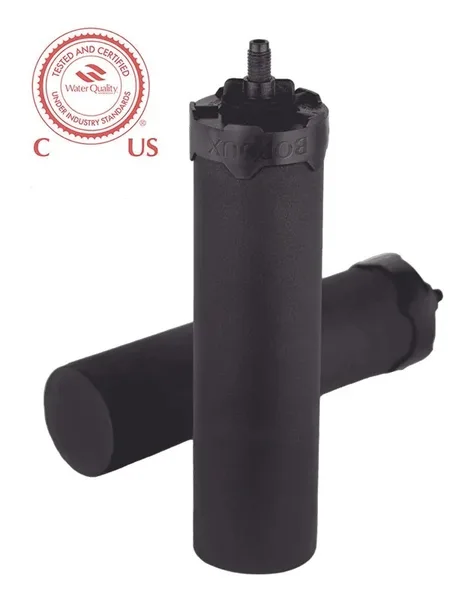
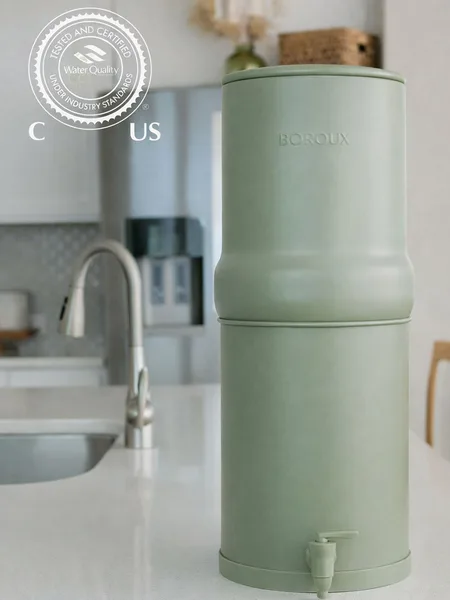
One example is the BOROUX Foundation. For the Foundation filter, BOROUX describes several filtration mechanisms, including activated carbon filtration and ion exchange. That combines two techniques that the EPA also names for PFAS reduction.
On its own, however, that is not yet proof of the filter's actual PFAS performance. That is why independent laboratory results matter more than the filtration technique used alone.
How well does BOROUX Foundation filter PFAS?
The BOROUX Foundation filter has been independently tested by IAPMO R&T Lab in New Jersey. The PFAS reduction was tested using the test methodology of NSF/ANSI Standard 53. The filter passed this PFAS reduction test up to a capacity of 400 gallons per filter element, or roughly 1,514 litres.
This means that the filter was tested according to this NSF/ANSI 53 test method. It does not mean that the BOROUX Foundation is fully NSF/ANSI 53 certified for PFAS.
What is particularly interesting is that the laboratory report does not only speak of 'PFAS' in general terms, but looked at several PFAS individually.
| PFAS tested | Concentration before filtration* | Concentration after 400 gallons* | Result |
|---|---|---|---|
| PFOA | 0.50 µg/L | 0.01 µg/L | approx. 98% reduction |
| PFOS | 1.10 µg/L | 0.01 µg/L | approx. 99.1% reduction |
| PFOA + PFOS | 1.60 µg/L | 0.02 µg/L | approx. 98.8% reduction |
| PFNA | 0.05 µg/L | <0.001 µg/L | >98% reduction |
| PFHxS | 0.29 µg/L | <0.01 µg/L | >96.5% reduction |
| PFHpA | 0.04 µg/L | <0.01 µg/L | >75% reduction |
| PFBS | 0.28 µg/L | Not reported** | No separate reduction percentage available |
| PFDA | 0.01 µg/L | Not reported** | No separate reduction percentage available |
| Total PFAS | 2.27 µg/L | 0.02 µg/L | approx. 99.1% reduction |
Values at the measuring point after 400 gallons, roughly 1,514 litres, per filter element. A < value means that the measured concentration was below the stated reporting or detection limit.
** PFBS and PFDA were included in the laboratory test and the report states influent values for them. However, no effluent concentrations are reported for these two individual PFAS. A separate reduction percentage for PFBS and PFDA therefore cannot be calculated from the published report. Both substances were, however, included in the total PFAS measurement.
In the total PFAS measurement, the concentration before filtration was 2.27 µg/L. After 400 gallons of filtration, 0.02 µg/L was measured.
At the end of the tested capacity, that amounts to a reduction of roughly:
99.1% of the total tested PFAS concentration.
We consider that an important detail. The percentage is based on the measurement after 400 gallons (roughly 1,514 litres), and not just on the performance of a new filter at the start of the test.
Does 99.1% mean that BOROUX always removes 99.1% of all PFAS?
No.
We think this distinction is important.
The laboratory test shows how the BOROUX Foundation filter performed with the PFAS tested under set test conditions. It does not mean that exactly the same reduction percentage will be achieved in every real-life situation.
Actual performance can vary because of, among other things:
- the composition and quality of the water;
- the concentration of PFAS;
- other substances present in the water;
- the amount of water that has already passed through the filter;
- the conditions of use.
In addition, PFAS is a collective name for thousands of different substances. The fact that a filter demonstrably reduces several PFAS therefore does not automatically mean that the same reduction percentage applies to every PFAS that exists.
That is why we find the wording:
'BOROUX Foundation reduced roughly 99.1% of the total tested PFAS concentration at the end of the independent laboratory test'
more accurate than:
'BOROUX removes 99.1% of all PFAS.'
That difference may seem small, but it matters if you want to compare water filters fairly and on the basis of measurable results.
How long does a filter keep reducing PFAS?
A reduction percentage says little unless you know up to how many litres the filter was tested.
The BOROUX Foundation PFAS test ran up to 400 gallons per filter element, or about 1,514 litres.
When two Foundation filter elements are used, this corresponds to a tested PFAS capacity of about 800 gallons, or 3,028 litres per pair.
That does not mean a filter suddenly stops reducing PFAS after exactly 3,028 litres. It does mean that, for a well-founded PFAS claim, you should not simply state a larger capacity than the one for which the performance has actually been demonstrated.
This is also why a single general lifespan for a water filter can be misleading. The tested capacity can differ per contaminant.
A filter may, for example, have been tested for chlorine up to a much larger volume of water than for PFAS. If you specifically want to reduce PFAS, you are well advised to look at the capacity tested for PFAS and not only at the filter's general maximum lifespan.
What should you look out for when buying a water filter for PFAS?
Don't just look at big claims on a package or in an online shop. Ask a few concrete questions instead:
1. Has the filter actually been tested for PFAS?
'Contains activated carbon' is not, on its own, proof of the PFAS performance of a complete filter.
2. Which PFAS were tested?
A test on PFOA and PFOS alone is something different from a test in which several PFAS are included individually.
3. Who carried out the test?
A test by an independent laboratory gives you more to go on than a claim from the manufacturer alone.
4. Up to how many litres was the filter tested?
An impressive reduction percentage at the start of the filter's life does not yet tell you how the filter performs later on. So also look at the measurements at the end of the tested capacity.
5. What was the concentration before and after filtration?
With these values you can judge far better what was actually measured than with a rounded reduction percentage alone.
6. Has the filter been tested or certified?
Those are not automatically the same thing. A product can be independently tested according to a particular NSF/ANSI test method without the complete product being NSF certified for that claim.
So what is the best water filter against PFAS?
There is no single water filter that is the best choice for everyone.
If you want the widest possible removal of dissolved substances and you don't mind a fixed installation and waste water, reverse osmosis may be interesting.
If, on the other hand, you want a simple system without electricity and without a connection to the water mains, a gravity water filter with filter elements demonstrably tested for PFAS may be an interesting choice.
Ultimately, what matters most is not just the name of the technique or the brand.
The test results of the specific filter element must support the claim.
Conclusion
PFAS can be reduced in tap water. Activated carbon, ion exchange and reverse osmosis are among the techniques used for this.
Dutch tap water meets the legal requirements and can be drunk safely. An extra water filter is therefore not necessary to make tap water safe. People can, however, choose to reduce their exposure to PFAS via drinking water even further.
If you are buying a water filter for this purpose, you are well advised to look beyond the general claim 'filters PFAS'.
Look at:
- which PFAS were tested;
- how much was reduced;
- who carried out the test;
- under which conditions it was tested;
- up to how many litres that performance has been demonstrated.
For BOROUX Foundation, for example, an independent laboratory test has shown that at the end of the tested capacity of 400 gallons per filter element, the filter reduced roughly 99.1% of the total tested PFAS concentration.
Measurable data of this kind makes it possible to compare water filters in a much fairer way.
FREQUENTLY ASKED QUESTIONS ABOUT PFAS AND WATER FILTERS
Is there PFAS in Dutch tap water?
Yes. Small amounts of PFAS can be present in Dutch drinking water. According to the RIVM, average exposure through drinking water alone is below the health-based limit value, and Dutch tap water can simply be drunk.
Can activated carbon remove PFAS?
Activated carbon can reduce PFAS in water. However, its effectiveness varies by PFAS, filter material, contact time and conditions of use. Longer PFAS such as PFOA and PFOS are generally adsorbed better by activated carbon than some shorter PFAS.
Can ion exchange remove PFAS from water?
Yes. Ion exchange can effectively reduce certain PFAS in water. In this process, PFAS are bound to a special filter material. According to the EPA, ion exchange, alongside activated carbon and reverse osmosis, is one of the techniques that can be used for PFAS reduction. Actual effectiveness depends on the filter material used, the specific PFAS and the conditions in which the filter is used.
Does reverse osmosis remove PFAS?
According to the EPA, reverse osmosis is a very effective technique for reducing PFAS. An RO system also removes many other dissolved substances and a large share of the naturally occurring dissolved minerals.
Does BOROUX filter PFAS?
Yes. BOROUX Foundation has been tested by IAPMO R&T Lab for PFAS reduction according to the test methodology of NSF/ANSI Standard 53. At the end of the test, after 400 gallons per filter element, a reduction of roughly 99.1% was measured for the total tested PFAS concentration. This does not mean that BOROUX Foundation is fully NSF/ANSI 53 certified for PFAS. It means that the PFAS performance has been independently tested according to this test methodology.
Does every gravity filter remove PFAS?
No. 'Gravity filter' mainly describes how the water flows through the system. The actual reduction of PFAS depends on the filter element used. So check the independent test results of the specific filter.
Do I need a water filter to drink Dutch tap water safely?
No. The Dutch government and the RIVM state that Dutch tap water can simply be drunk. An additional water filter can be used, however, if someone wants to reduce certain substances, such as PFAS, even further.
Sources
- RIVM – PFAS in drinking water - Information on PFAS in Dutch drinking water, exposure, legal requirements and the health-based guideline value
- RIVM – Method for assessing PFAS in drinking water samples - Explanation of the guideline value of 4.4 ng/L PFOA equivalents and the RPF method
- Rijksoverheid – Is there PFAS in drinking water? - Information from the Dutch government on PFAS and the safety of Dutch tap water
- US Environmental Protection Agency – Reducing PFAS in Drinking Water with Treatment Technologies - Information on activated carbon, ion exchange, nanofiltration and reverse osmosis
- US Environmental Protection Agency – Identifying Drinking Water Filters Certified to Reduce PFAS - Explanation of the certification of water filters for PFAS reduction, including NSF/ANSI 53 for filters and NSF/ANSI 58 for reverse osmosis. The EPA also explains what such a certification does and does not say about actual PFAS reduction
- IAPMO R&T Lab – BOROUX Foundation PFAS Reduction Test, Report #23-199-2-PFAS - Independent laboratory test according to NSF/ANSI Standard 53 for PFAS reduction
From the shop
Berkey
BOROUX Foundation Black filter elements (2 pieces)
BOROUX
BOROUX Legacy Compact water filter 6.8L
BOROUX
BOROUX Legacy Compact water filter white 6.8L
BOROUX
BOROUX Legacy Compact water filter black 6.8L
BOROUX
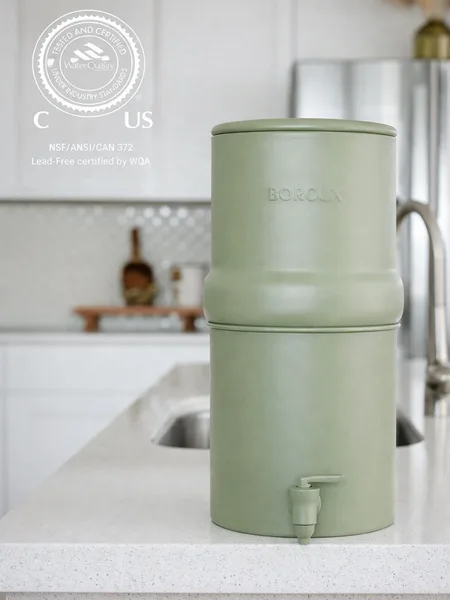
BOROUX Legacy Compact water filter sage green 6.8L
BOROUX
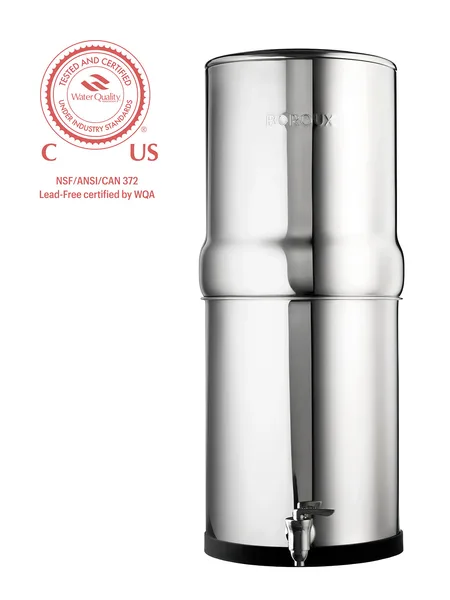
BOROUX Legacy water filter 11.4L
BOROUX
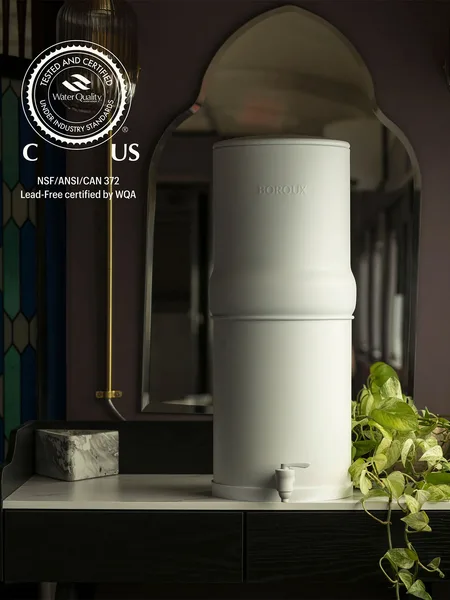
BOROUX Legacy water filter white 11.4L
BOROUX
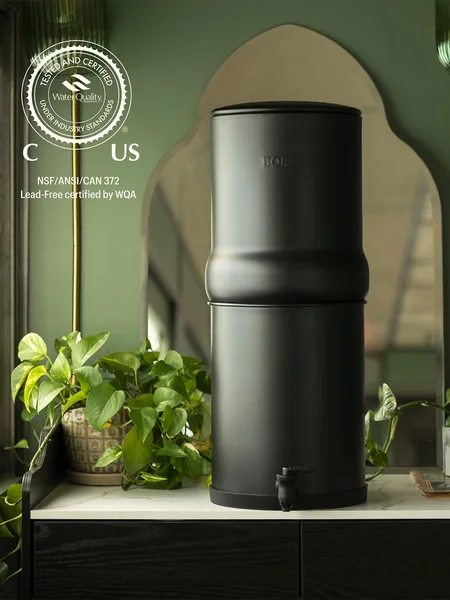
BOROUX Legacy water filter black 11.4L
BOROUX